
Split grommet or split frame?
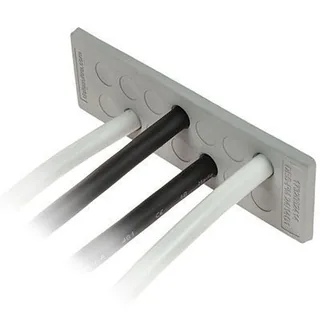
Count both the cables and the holes you are allowed to drill. One grommet per cable means one M hole per cable: ten cables means machining ten holes. A frame needs one rectangular cut-out and immediately provides room for ten to thirty cables, including blanks for later.
Why is strain relief mandatory?
A grommet seals and protects the sheath against the sharp sheet edge, but does not hold the cable. Without relief, every pull on the cable lands directly on the terminals or connector. So fit a strain-relief comb or clamp within 100 mm behind the entry, even if the cable 'does not move anyway'.
Which IP rating does a frame achieve?
With correctly chosen grommets (cable diameter within the stated range) and a flat, smooth wall, most frames achieve IP54 to IP66. Blanks must be fitted: one empty hole drops the rating to nothing. For IP66 and above, also mind the seal between frame and wall.
How much spare capacity do you plan?
Plan 20% blank grommets. A later expansion then costs a few euros for a grommet instead of re-machining a cabinet wall with the machine in production. Also document which grommet size belongs to which cable; that saves a lot of searching during service.
| Tipo | Cable count | IP rating | Cut-out |
|---|---|---|---|
| Deelbare tule | 1 | IP54–IP66 | Rond M16–M63 |
| Snapdoorvoer | 1 | IP54 | Rond, klikt vast |
| Klein frame | 4–10 | IP54–IP66 | Rechthoek 46 × 46 |
| Groot frame | 10–30 | IP54–IP66 | Rechthoek 112 × 46 |
Frequently asked questions
- Can I fit a frame in an existing cabinet?
- Yes, provided you can make a rectangular cut-out and there is room behind the wall. Existing gland holes can be sealed with blanking plugs or used for strain relief.
- Are split grommets suitable for moving cables?
- Not as the seal of a moving point. For a cable coming out of a carrier, always place the entry behind the strain relief, in the static section.
- Which sizes do you keep in stock?
- Common grommet sizes and frames are in stock; filter the catalogue on stock to see it instantly. Special sizes usually ship within two to three weeks.
Products from this article
Available from stock, with volume discounts from 10 pieces.

Read next
- What do IP ratings mean for cable protection conduits?The two digits explained, plus why a conduit only achieves an IP rating together with its gland.
- How do you correctly fill cables into a cable carrier?From unrolling and neutral position to strain relief: a seven-step installation sequence with the most frequent mistakes.
- How do you protect cables against heat and weld spatter?Continuous versus peak temperature, radiant heat and spatter: which protection type suits which heat source.