
Which entry types exist?
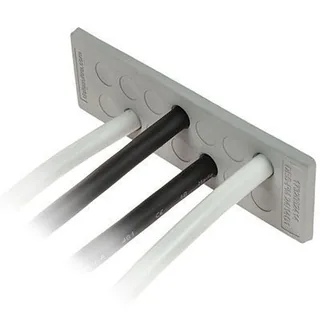
Broadly four: the classic gland for a single cable, the membrane grommet that closes around the cable sheath, the split frame holding several grommets side by side, and the brush or foam seal for bundles where sealing is not required. In addition there are pressure-resistant entries for ATEX and fire-rated entries for wall penetrations.
- Gland: single cable, highest IP rating, cheapest per unit.
- Membrane grommet: loose cable without connector, fast to fit, IP66 possible.
- Split frame: connectorised cables, high packing density per m² of wall.
- Brush: large bundles, no IP claim, but dust and rodent protection.
Why a split frame for connectors?
A pre-terminated cable with an M12, Harting or RJ45 connector will not pass through a closed opening without removing the connector. A split frame opens, the cable is laid sideways into the grommet, and the frame bolts shut; the grommet clamps the sheath and seals. This saves assembly time and prevents errors from re-terminating.
Which sealing level do you get with what?
A frame with sealed grommets and a perimeter gasket reaches IP54 to IP66, provided every unused grommet is filled with a blanking plug and the bolts are tightened crosswise. Brush seals achieve no IP rating: they are intended against dust, chips and rodents, for example under a machine frame or in a cable duct.
An entry is also strain relief
EN 60204-1 requires connections to be free of tension. Clamping grommets provide part of that strain relief, but with heavy or moving cables fit a separate clamping rail 100 to 200 mm behind the entry. That keeps force away from the terminal strip and preserves the seal.
| Type | Connector possible | Sealing | Typical application |
|---|---|---|---|
| Wartel | Nee | IP66–IP68 | Enkele kabel in kast |
| Membraantule | Nee | IP66 | Losse kabels, hoge dichtheid |
| Geteeld frame | Ja | IP54–IP66 | Machinebouw, servicewand |
| Borstelafdichting | Ja | Geen IP | Kabelgoot, machineframe |
| Brandwerende doorvoer | Beperkt | EI30–EI120 | Wanddoorbraak gebouw |
Frequently asked questions
- Can I extend a frame later?
- Yes, provided you fit blanking plugs on the spare positions now. Later simply swap a plug for a grommet without cutting the enclosure.
- Are entry frames EMC-capable?
- Only in versions with conductive grommets or contact springs that contact the cable screen all round. A standard plastic grommet insulates and provides no shield continuity.
- Which cut-out should I make in the enclosure wall?
- Each frame type has an exact cut-out dimension with hole pattern given by the maker; find it in the datasheet on the product page. Do not deviate, as the gasket seals on that dimension.
Products from this article
Available from stock, with volume discounts from 10 pieces.

Read next
- Which cable entry do you choose for pre-terminated cables?Split grommet, frame or snap entry: packing density, IP rating and strain relief compared.
- How many grommets and which frame size do you need?From cable list to frame size: grommet size per diameter, occupancy rules and 20% reserve.
- Installing an entry frame: sequence, sealing and checksFrom cut-out to final check: the eight steps that decide whether your frame really seals.