
How long is the travel?
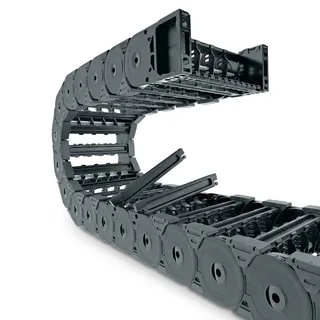
Up to 6 metres unsupported, plastic stays comfortably within its sag specification. Between 6 and 15 metres, choose plastic gliding in a trough or steel unsupported with a taller side band. Above 15 metres with heavy fill, steel with support rollers becomes the standard because friction in a plastic glide trough gets too high.
How heavy is the fill?
Add the weight per metre of all cables and hoses, including medium: a Ø 16 mm hydraulic hose already weighs over 0.6 kg/m when filled. Above 10 kg/m combined with more than 4 metres of travel, plastic reaches its limit; above 15 kg/m we recommend steel or aluminium as standard.
What happens in the environment?
Plastic handles roughly 100 °C continuously and tolerates short peaks, but glowing swarf burns into it. For turning shops, welding robots and cutting machines, choose steel, optionally with a sheet-steel swarf cover. Aggressive coolants or solvents: always request the chemical resistance list before ordering.
Do noise or speed matter?
Above 3 m/s plastic is markedly quieter and induces fewer vibrations in the machine. If steel is unavoidable in a manned area, choose a version with plastic glide elements and polymer pins — in practice that saves 5 to 10 dB(A).
| Criterion | Plastic | Steel | Threshold |
|---|---|---|---|
| Vrijdragende slag | ✔ | ✔ | ≈ 6 m |
| Vulgewicht | ≤ 10 kg/m | ≤ 40 kg/m | 10–15 kg/m |
| Temperatuur continu | ≤ 100 °C | ≤ 250 °C | 100 °C |
| Hete spanen / lasspat | — | ✔ | n.v.t. |
| Snelheid | ≤ 10 m/s | ≤ 5 m/s | 3 m/s |
Frequently asked questions
- Is aluminium available as a middle ground?
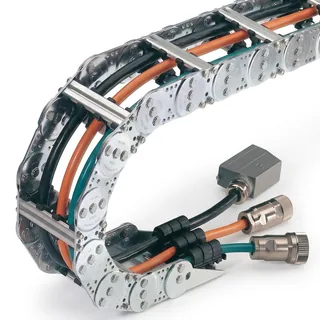
- Yes, hybrid chains with aluminium crossbars and plastic side bands are lighter than steel and carry more than all-plastic. They suit long travels at moderate temperatures.
- Roughly how much more expensive is steel?
- Expect a factor of 2 to 3 on the chain itself, plus heavier mounting and more installation time. Request a quote with both variants to see the exact difference for your size.
- Can I run a plastic chain in an existing steel trough?
- Often yes, provided the trough width matches the chain's outer width and glide shoes or glide surfaces are present. Send us the trough dimensions and we will check.
Products from this article
Available from stock, with volume discounts from 10 pieces.
Read next
- Which cable carrier series fits my machine?Series differ in pitch, side-band height and radius range. How to derive the right series from your own dimensions in four steps.
- How do you calculate unsupported length and sag?Fill weight sets the unsupported length. When to switch to gliding, and how much sag is acceptable.
- How do you protect cables against heat and weld spatter?Continuous versus peak temperature, radiant heat and spatter: which protection type suits which heat source.