
How much heat must the cables shed?
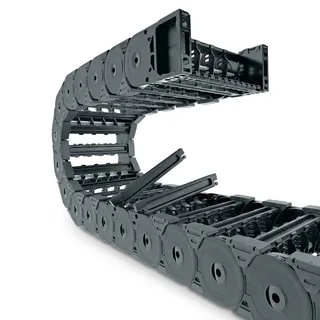
Servo and motor cables heat up from current and losses. In a closed chain that heat accumulates and the cable maker requires current derating. For power cables of 4 mm² and up we therefore stick to open crossbars unless the environment forbids it.
What lands on the chain?
Dry swarf slides off a closed cover; wet swarf with coolant sticks and forms an abrasive paste. In that case choose a cover with a slight roof shape or a swarf shield above it, and schedule periodic blow-out in the maintenance plan.
Is high-pressure cleaning used?
In food and pharma the chain is part of the cleaning regime. Closed versions with a flat outer surface and no open screw holes rinse off; open crossbars trap water in the compartments. Ask for versions with rounded covers and FDA-compliant materials.
What does a closed version cost extra?
Expect 15 to 30% more per metre, plus slightly more installation time. That nearly always beats a single cable failure: a chafed servo cable costs alignment and testing on top of the part.
| Environment | Crossbar type | Cooling | Cleanable |
|---|---|---|---|
| Schone montagehal | Open | ++ | + |
| Droog stof / hout | Gesloten / closed | + | + |
| Natte spanen | Deksel + afdekking | − | + |
| Food, hogedruk | Gesloten glad / smooth | − | ++ |
Frequently asked questions
- Can I combine open and closed crossbars?
- Yes, we do that often: closed covers on the upper run where swarf falls and open crossbars on the lower run for cooling and dirt drainage.
- Is a closed cable carrier IP-rated?
- No. A carrier is never a seal; it stops coarse dirt and splashes. If you need genuine tightness, run a protective conduit with a gland inside the chain.
- Which version ships from stock?
- Open crossbars of the common series are in stock; closed covers and special materials usually ship within two to three weeks.
Products from this article
Available from stock, with volume discounts from 10 pieces.

Read next
- Openable inwards or outwards: which do you choose?The opening direction decides whether you can fill cables without dismantling the machine. Four criteria and a decision table.
- Plastic or steel cable carrier: when do you choose which?Travel, fill weight, temperature, swarf and noise decide — with concrete thresholds per criterion.
- How do you protect cables against heat and weld spatter?Continuous versus peak temperature, radiant heat and spatter: which protection type suits which heat source.