
Which parts make up a cable carrier?
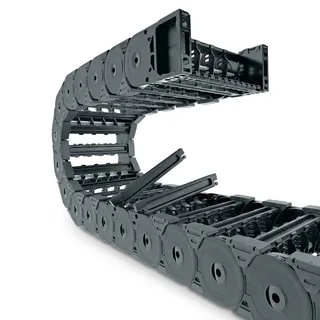
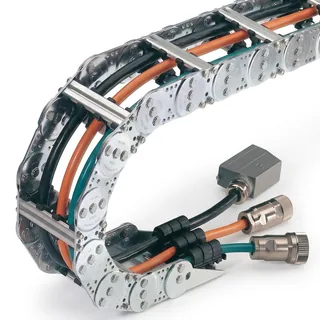
Every carrier consists of two side bands of links, joined by crossbars. Links are connected with pins or clips and have a stop that limits the bend radius. Crossbars sit on top and bottom: open, closed or as a cover.
- Side band with links — sets pitch, bend radius and permissible load.
- Crossbars or covers — close the link and define the inner height.
- Separators and shelves — keep cables in their own compartment.
- End connectors — link the chain to machine and driver; always required.
Which dimensions do you need to know?
Four dimensions decide whether a chain fits: inner height (Hi), inner width (Bi), bend radius (R) and pitch (the length of one link). Outer height and width then decide whether the chain fits the machine or trough. Note: catalogues sometimes quote the outer dimension as 'height' — we always show the true inner dimension.
How does the chain move over the travel?
On short travels the chain carries itself: the upper run hangs freely above the lower run (unsupported). As the travel grows, the upper run sags and comes to rest on the lower run — the gliding arrangement. From then on you need a guide trough and glide shoes.
When do you need a cable carrier?
As soon as a cable bends more than a few thousand times a year, a loose trailing loop is not enough. Think gantries, saw carriages, robot axes, crane runways and linear axes in CNC machines. For static installations a protective conduit or cable tray is sufficient.
| Inner height Hi | Inner width Bi | Bend radius R | Typical travel |
|---|---|---|---|
| 7–10 mm | 10–30 mm | 28–50 mm | ≤ 1 m |
| 15–18 mm | 25–75 mm | 50–100 mm | 1–3 m |
| 25–32 mm | 50–150 mm | 100–200 mm | 3–6 m |
| 40–56 mm | 100–300 mm | 150–350 mm | 6–15 m |
Frequently asked questions
- Can I put a standard cable in a cable carrier?
- Only at very low cycle counts. Moving applications need a flexible cable with fine-stranded conductors and a bundled core; a fixed installation cable breaks after a few tens of thousands of strokes.
- How long does a plastic cable carrier last?
- With correct fill, radius and speed, plastic chains typically reach millions of double strokes. Premature failure is nearly always caused by overfilling, too small a radius or dirt inside the chain.
- Can I shorten or extend a cable carrier?
- Yes. Plastic chains open link by link; you remove or add whole links and refit the end connector. Mind the pitch: the length always changes in steps of one link.
Products from this article
Available from stock, with volume discounts from 10 pieces.
Read next
- How do you determine the inner height and inner width of a cable carrier?Measure the fill, add clearance and divide compartments — including the 60% rule of thumb and a full worked example.
- How do you calculate the size and length of a cable carrier?Five steps from fill to orderable chain length, with the formula Lk = S/2 + π × R + allowance and a full example.
- Plastic or steel cable carrier: when do you choose which?Travel, fill weight, temperature, swarf and noise decide — with concrete thresholds per criterion.