
Which heat route dominates in your case?
Measure at three points: the heat source surface, the air at cable height and the cable sheath itself. If the source surface is far hotter than the air, radiation dominates and shielding helps. If the air is just as hot, convection dominates and you need ventilation or a different cable route; insulation alone then only moves the problem.
Materials and their limits
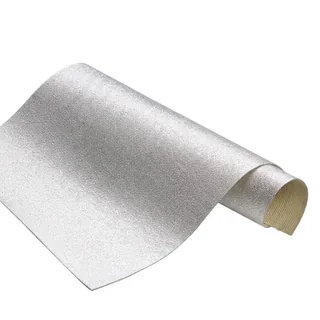
Glass-fibre sleeves with silicone coating run continuously to about 260 °C and higher briefly; aluminium/glass-fibre mats reflect up to 80% of radiation and take 300 °C continuously. Pure silica or ceramic fabric handles 1000 °C but is brittle and only sensible close to melting furnaces. PTFE sleeves reach 260 °C and are chemically resistant too.
What does the cable itself tolerate?
A PVC sheath is at its limit above 70 °C, PUR reaches 90 °C, cross-linked materials (XLPE) 90 to 120 °C and silicone 180 °C. Important: the stated limit is the conductor temperature, not the ambient. At high ambient you must derate current or choose a larger conductor size.
Distance is the cheapest protection
Radiant heat falls with the square of distance: twice as far means a quarter of the load. Before buying material, check whether the cable route can shift 200 mm, whether the bundle can run on the cool side of a beam, or whether an existing plate can serve as a shield.
| Material | Continuous | Peak | Works against |
|---|---|---|---|
| Glasvezel + silicone | 260 °C | 350 °C | Straling, contact |
| Alu-glasvezelmat | 300 °C | 550 °C | Straling |
| PTFE-sleeve | 260 °C | 300 °C | Straling, chemie |
| Silicaatweefsel | 1000 °C | 1200 °C | Straling, spatten |
| RVS overbraiding | 300 °C | 600 °C | Contact, mechanisch |
Frequently asked questions
- Does a heat sleeve also help against weld spatter?
- Only in a spatter-resistant version, usually with a silicone or vermiculite coating. Bare glass fabric catches the spatter but melts locally.
- Can I use a heat sleeve inside a cable carrier?
- Only flexible thin-wall versions and with extra clearance in the carrier. Stiff sleeves raise restoring force and wear the side bands.
- Why does a shielded cable still feel warm?
- Because the cable also produces its own loss heat. Shielding blocks external heat but traps internal heat too; hence always an air gap and, if needed, derating.
Products from this article
Available from stock, with volume discounts from 10 pieces.
Read next
- How do you protect cables against heat and weld spatter?Continuous versus peak temperature, radiant heat and spatter: which protection type suits which heat source.
- Calculating derating at high ambient temperatureTwo factors, one formula: how much current remains at 55 °C with ten cables side by side?
- Installing heat protection: air gap, fixing and inspectionA good shield hangs free, is fixed with heat-resistant hardware and is checked annually.