
Choose your delivery country
Ships today when ordered before 15:00 CETShips today when ordered before 15:00 CET
Wisman Group

Application

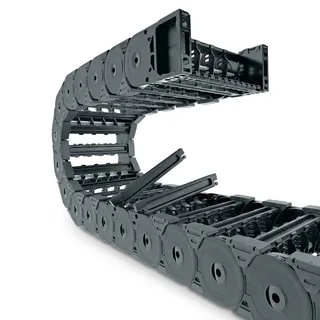
Cable carrier for woodworking machines

Wood dust is fine, dry and gets everywhere. In nesting machines, edgebanders and beam processing centres, dust management decides how long a cable carrier lasts. We supply plastic energy chain that is sealed, runs light and handles the high speeds of modern gantries without rattling.

  • Enclosed versions that keep wood dust out of the carrier
  • Light and quiet: plastic with a trough for fast nesting gantries
  • Room for extraction hose, vacuum hose, compressed air and servo cables
  • Ex stock, with STEP files for your design

On working days you receive a tailored quotation by email within 3 hours.

Dust is the real enemy

Wood dust acts as an abrasive. Between the pins and holes of the links it increases play and the carrier starts to rattle; between the cables it wears through the jacket locally. An enclosed version with cover strip, combined with good extraction along the axis, therefore matters more than picking a heavier series.

Speed and noise on nesting machines

Nesting gantries easily reach 60 to 100 m/min. At that speed you immediately hear whether a carrier is properly guided. With the upper run in a trough and the fill neatly distributed, noise stays low and motion stays calm. Without a trough the carrier slaps up and down at the reversal point, and that is exactly where breakage starts.

Vacuum, extraction and cables in one carrier

In woodworking, thick vacuum or extraction hoses often sit next to servo cables. Under vacuum hoses become stiffer and press against the side wall. Give them their own layer below the cables, allow slightly more width clearance than the 10% you use for cables, and keep the bend radius generous: at least ten times the hose outer diameter for thick hoses.

Edgebanding and hot glue

Edgebanders add heat and glue fumes to the dust. As long as the carrier stays within the plastic's ambient temperature, an enclosed version is ideal; if the axis sits right next to the glue pot or melting tank we look at a steel version or extra shielding.

Back in production fast

A stopped woodworking machine costs money per hour. Stock items ship the same working day when ordered before 15:00, and we can deliver the carrier fully assembled so the technician only replaces the end connectors.

Before you order: woodworking checklist

  • Enclosed version with cover strip against wood dust.
  • Guide trough from about 1.5 m unsupported length.
  • Thick hoses at the bottom, cables above, separate chambers.
  • Bend radius at least 10× the thickest hose.
  • Clearance: 10% for cables, slightly more for hoses.

Machine down? Act straight away

Send dimensions or a photo of the current carrier through the quotation form. On working days you receive a suitable proposal, including lead time, within three hours.

Know your travel, fill and bend radius? Calculate your cable carrier in two minutes in the configurator — or let us check it for you.

Frequently asked questions

Why does my carrier rattle so quickly in a nesting machine?
Almost always dust in the link joints combined with an unguided axis. An enclosed version and a guide trough usually solve it in one go.
Can a vacuum hose share the carrier with servo cables?
Yes, as long as you separate them with dividers and give the hose its own layer. Under vacuum the hose stiffens and must not crush the cables.
Is plastic quiet enough for a workshop?
Plastic is clearly quieter than steel. For even less noise, a guided axis, even fill distribution and a trough make the difference.
Can you match an existing carrier?
In most cases yes. With a photo, the inner dimensions and the bend radius we find the Kabelschlepp equivalent, whatever brand is fitted now.