
Choose your delivery country
Ships today when ordered before 15:00 CETShips today when ordered before 15:00 CET
Wisman Group

Range

Small cable carriers: compact, light and quiet

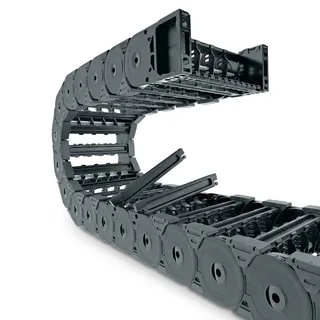
Not every axis needs a heavy chain. For short travels, thin cables and limited installation space there are small cable carriers with inner heights from just a few millimetres — popular in handling, lab automation, electronics production, medical equipment and compact linear axes.

  • Inner heights from a few millimetres, very narrow versions
  • Light and virtually silent: suitable for labs and office environments
  • Small bend radii for limited installation height
  • Ex stock, also in small quantities per piece or per metre

On working days you receive a tailored quotation by email within 3 hours.

Where small chain belongs

Small cable carriers sit in pick-and-place units, dosing heads, lab robots, print heads, camera axes and compact Z axes. Typical features: thin signal and supply cables, sometimes a thin hose, short travels and very little room. The advantage is not only size but weight — a light carrier costs less of your dynamics and makes less noise.

The pitfall: bend radius too small

In compact designs the bend radius is almost always chosen too small because there is simply no space. Still the rule holds: at least ten times the outer diameter of the thickest cable, more for shielded cables. If that does not fit, the answer is not the carrier but the cable: pick a thinner, highly flexible type intended for moving applications.

Fill and clearance in narrow chambers

Mistakes show faster in narrow chain. Keep 10% clearance across the width, let cables lie free without bundling them with cable ties, and make sure every cable can move in the arc. Bundling is the most common mistake: a fixed bundle cannot absorb the length differences in the arc and tears the jacket apart.

Very high cycle counts

Compact axes often make millions of short strokes a year. At those numbers the cable quality determines the life of the whole assembly. Choose cables with fine-stranded, highly flexible conductors and a jacket suited to drag applications, and give the cable room in the carrier to absorb its own length difference.

Available separately too

Small chain can be ordered per metre or per piece with matching end connectors. That makes it ideal for prototypes and one-off machines: no hundred-metre minimum, just what you need, shipped from stock.

Before you order: micro checklist

  • Outer diameter of the thickest cable × 10 = minimum bend radius.
  • Inner height set by the thickest cable, not the average.
  • Width: sum of diameters + 10% clearance.
  • No cable ties in the moving zone.
  • Choose highly flexible cable at high cycle counts.

Compact axis, little space?

Calculate your axis in the configurator or send your installation dimensions via the quotation form — a suitable proposal within three hours on working days.

Know your travel, fill and bend radius? Calculate your cable carrier in two minutes in the configurator — or let us check it for you.

Frequently asked questions

What is the smallest cable carrier you supply?
We supply micro versions with inner heights from a few millimetres. Tell us your cable package and available space and we will name the smallest series that is still technically sound.
Can I run a single thin cable in a small carrier?
Yes, that is a common application. Just make sure the cable is not pinched and the bend radius suits that cable.
Is small chain sold by the metre?
Yes, per metre or per number of links, with end connectors. Even one metre for a prototype is no problem.
Why does my thin cable break inside the carrier?
Usually because the bend radius is too small, the cables are bundled, or the cable is not designed for moving applications. All three are easy to fix.