
Choose your delivery country
Ships today when ordered before 15:00 CETShips today when ordered before 15:00 CET
Wisman Group

Explained

What is a cable chain?

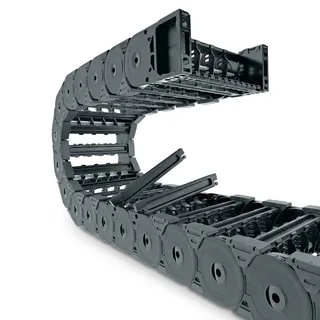
A cable chain is a linked guide that carries cables and hoses along moving machine parts. It keeps the wiring on a fixed path within a fixed bend radius and prevents whipping, kinking and breakage. Other names: energy chain, drag chain, cable carrier and cable track.

  • Keeps cables within their permitted bend radius and extends their service life
  • Built from links with side parts and openable crossbars
  • Runs between a fixed and a moving end point with a bend arc in between
  • Available open, with a cover band or as a closed tube

How a cable chain works

The chain is fixed at one end and attached to the moving part at the other. Between those points sits the bend arc, which travels with the motion. On short strokes the upper run is unsupported; on longer strokes it glides on the lower run inside a glide channel. That way the wiring stays put and only the chain moves.

Parts of a link

A link consists of two side parts and crossbars that open on the inside or the outside. Separators divide the interior into compartments so power cables, data buses and hoses do not chafe against each other. End connectors join the chain to the machine and the moving part and absorb the tensile force — the cables themselves must never carry that load.

Fill rate and bend radius: the two critical figures

Never fill a compartment beyond roughly 60%: cables must be able to move. The bend radius is at least ten times the diameter of the thickest cable, and twelve to fifteen times for shielded or heavy power cables. Too small a radius is the most common cause of cable failure in practice. Both figures are listed on every item.

Other names for the same part

Cable chain, energy chain, drag chain, cable carrier and cable track are used interchangeably. German: Energiekette, Schleppkette, Kabelschleppkette or E-Kette; Dutch: kabelrups; French: chaîne porte-câbles; Spanish: cadena portacables or cadena de arrastre.

  • cable chain
  • drag chain
  • energy chain
  • cable carrier
  • cable track
  • cable chains

Frequently asked questions

What is a cable chain used for?
Any application where cables or hoses travel with a moving part: gantry robots, linear axes, machine tools, packaging lines, cranes and sliding doors. The chain protects the wiring and keeps the motion predictable.
What is the difference between a cable chain and a drag chain?
Nothing — they are two names for the same component, as are energy chain and cable carrier.
Which cable belongs in a cable chain?
A flexible cable rated for continuous movement, with a bend radius that suits the chosen chain. Standard installation cable is not designed for it and fails under repeated motion.