
Choose your delivery country
Ships today when ordered before 15:00 CETShips today when ordered before 15:00 CET
Wisman Group

Engineering

Cable carrier service life: what determines it?

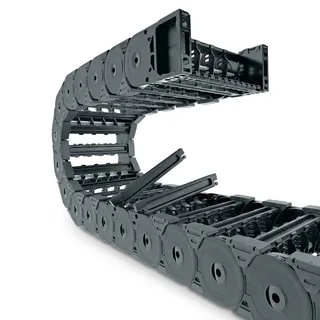
A cable carrier is measured in double strokes, not years. A properly sized plastic carrier reaches millions of double strokes in practice; the same carrier with a bend radius that is too small or an overfilled chamber sometimes does not last six months. These five factors decide how far you get — and they are all design choices.

  • Bend radius is factor one: too small costs life immediately
  • Keep the fill level below 60% and let cables move freely
  • Guidance: a trough lowers wear on long travels
  • Environment: chips, dust, heat and chemicals dictate the design

On working days you receive a tailored quotation by email within 3 hours.

1. Bend radius: the most important choice

The bend radius determines how hard the cable and the carrier are loaded per stroke. The rule of thumb is at least ten times the outer diameter of the thickest cable, and twelve to fifteen times for shielded or heavy power cables. Every millimetre you give up here to save space you pay back in early cable failure — which is almost always a more expensive breakdown than the carrier itself.

2. Fill level and distribution

Keep the fill level below 60% and distribute weight symmetrically: heavy cables near the neutral line, thin signal cables outside them, hoses in their own layer. Cables must be able to move in the arc to absorb length differences. Cable ties in the moving zone are the most common cause of cable failure that has nothing to do with the carrier.

3. Speed, acceleration and cycle count

Speed alone is rarely fatal; the combination of high acceleration and an unguided axis is. High dynamics make the carrier whip, increasing wear and noise. Size the system with the real number of double strokes per day: a hundred strokes per hour on a production line is nearly a million per year.

4. Guidance and installation

From roughly one and a half to two metres unsupported length, the carrier belongs in a guide trough. That reduces sag, slapping noise and wear on the upper run. Also check the installation: fixed end and driver bracket in line, correct height, no obstacles in the moving zone and a trough without dents.

5. Environment and maintenance

Chips, wood dust, coolant emulsion, heat and cleaning chemicals decide whether you choose open, enclosed or steel. Plastic carriers are maintenance free and must not be lubricated; lubricant attracts dirt. What does help is a short periodic inspection: check for play in the links, worn jackets, loose dividers and dirt in the trough. That way you see a problem coming before the machine stops.

Service life checklist

  • Bend radius ≥ 10× (shielded: 12–15×) diameter of the thickest cable.
  • Fill level below 60%, weight distributed symmetrically.
  • No cable ties or bundles in the moving zone.
  • Guide trough when unsupported above about 1.5 m.
  • Periodic inspection: play, jackets, dividers, dirt.

Have your application calculated

Travel length, cable package, cycle rate and environment are enough. We check bend radius and fill and send a quotation with the right series within three hours on working days.

Know your travel, fill and bend radius? Calculate your cable carrier in two minutes in the configurator — or let us check it for you.

Frequently asked questions

How long does a cable carrier last?
With the correct bend radius, fill and guidance, plastic carriers reach millions of double strokes in practice — often many years of production. Badly sized, that can drop to months.
Do I need to lubricate a cable carrier?
No. Plastic carriers are maintenance free; lubricant attracts dust and chips and accelerates wear.
What usually fails first: carrier or cable?
Often the cable, and nearly always because of a bend radius that is too small, bundled cables, or a cable not intended for moving applications.
When should I replace it?
When there is audible play in the links, broken or deformed dividers, worn cable jackets or visible wear on the gliding surface. Replace the entire run at once.