
Choose your delivery country
Ships today when ordered before 15:00 CETShips today when ordered before 15:00 CET
Wisman Group
Sale20% off all cable carriersAll through September — the discount is already included in the prices.

Plastic cable carriers

Filter by inner height, inner width and bend radius. All dimensions are true inner dimensions in mm.

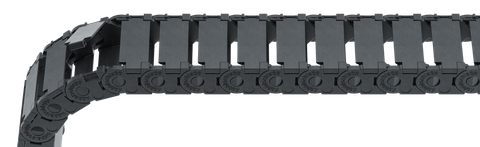
Plastic cable carriers guide cables, hoses and lines on moving machine parts. You select on true inner dimensions: inner height and inner width determine the fill, the bend radius determines how tightly the chain may run. Every series below is available open or enclosed, per metre or as a pre-assembled travel.

  • Ordered before 15:00, shipped the same day
  • Datasheet and STEP file with every article
  • Technical advice from a design engineer

Configurator

Cable chain configurator

Send us your cable list and we will calculate everything for you.

Calculate my cable chain

Can't find your cable carrier?

No problem — we're happy to prepare a tailored quote, including complete systems and special versions.

Request a tailored quote

588 articles

All about plastic cable carriers

Technical guidance from our engineers: how to choose, what to measure and where installations fail in practice.

How to determine the right inner dimensions

Lay out every cable and hose that has to travel and add up the outer diameters. Add 10% clearance: that is your minimum inner width. The thickest cable determines the inner height, because a cable must never be pinched between the crossbars. With multiple layers, stay below 60% fill ratio or friction — and therefore wear — rises quickly. If you are between two sizes, choose the larger one: an extra separator is cheaper than a second carrier.

Bend radius, travel and unsupported length

The bend radius should be at least ten times the diameter of the thickest cable — often twelve to fifteen times for shielded or heavy power cables. The travel determines the chain length: roughly half the travel plus the bend plus a small reserve. Beyond a series' unsupported length the carrier will sag; then pick a heavier series or let the upper run glide on the lower run in a guide trough.

Open or enclosed design

An open design with crossbars ventilates better and is easier to fill; choose it in clean environments and for warm power cables. An enclosed design (cover bands or tubes) keeps swarf, dust, coolant and sparks out and protects wiring on machine tools, laser cells and welding robots. Both are available openable — inside, outside or on both sides — so maintenance does not require dismantling the whole carrier.

Installation and maintenance

Install cables de-energised and without torsion, never twisted, and clamp them only at the end connectors with strain relief. Distribute heavy cables symmetrically across the width and separate power from signal with separators. At the first service, check the chain hook, the bolted joints and the sliding surfaces; audible wear or dust almost always means the bend radius is too small or the fill ratio too high.

Series in plastic cable carriers

Every series has its own page with the full size range, technical data and documentation.

Frequently asked questions

The questions our technical desk receives most often about this category.

How do I choose the right size of plastic cable carriers?

Start with the fill: the thickest cable sets the minimum inner height, the sum of all diameters plus 10% clearance sets the inner width. Then pick a bend radius of at least ten times the thickest cable diameter. Filter on those three values on the left and only suitable articles remain.

What is the lead time and when do you ship?

Articles marked 'in stock' ship the same working day when ordered before 15:00 CET. Articles 'on request' are made to order at the manufacturer; the lead time is stated in the quotation, typically 5 to 15 working days.

Do I get technical documentation and CAD files?

Yes. Every article lists a datasheet, a manual and a STEP file for your 3D model. All are free to download, no account required.

Are the prices volume prices?

The price shown is per unit. From the indicated tier quantity onwards the lower price applies automatically and is calculated in the cart. Use the toggle at the top to show prices including or excluding VAT.

How many metres of carrier do I need for my travel?

Rule of thumb: half the travel + the bend (π × bend radius) + roughly 200 mm reserve for the end connectors. With a 6 m travel and a 150 mm bend radius that gives about 3000 + 470 + 200 = 3.7 m. For hanging or vertical installations we are happy to calculate it for you.

Can I extend or repair an existing carrier?

Yes, as long as you use the same series and inner width. Individual links, crossbars and separators can be reordered per series. Series name no longer legible? Send a photo of one link plus the inner dimensions and we will identify the series.

What fill ratio is still acceptable?

Keep at most 60% of the inner cross-section filled and leave at least 10% clearance per cable in its chamber. Fuller carriers run heavier, hotter and louder, and jacket wear increases sharply.

Didn't find what you were looking for?

We'll prepare a tailored quote. Fill in the quote form and you'll receive a matching quote by email within 3 hours on working days.

Request a quote

Also known as

These products go by several names in the market. If you searched for any of these terms, you are in the right place:

  • cable carrier
  • energy chain
  • cable chain
  • plastic cable carrier
  • cable track
  • cable guide chain
  • cable drag chain carrier